WhatApp
+86-15522676451WhatApp
+86-15522676451
Traditional iron pipes rust easily, don’t last long, and are hard to maintain, which has long been a problem for sustainable community water sources. A system using Polyvinyl Chloride (PVC) for these pipes is now a key solution, creating “low-maintenance, long-lasting” community wells because of its excellent engineering qualities.
Part 1: The Underground Protectors: What Casing and Screen Pipes Do
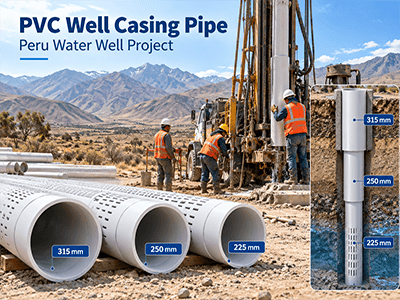
A community hand-pump well is more than just a pipe in the ground. It’s a precise system, where PVC casing and screen pipes play different but equally vital roles.
1.PVC Casing Pipe: The Well’s Strong Backbone
*Main Job: It forms a straight, solid, and sealed wall from the surface down. Its key tasks are to support the hole, prevent collapse, keep dirty surface water and contaminants out, and create a stable channel for the pump and water pipes.
Why PVC Works: It needs to be strong enough to handle pressure from the surrounding earth and must not corrode. PVC naturally resists chemical and electrochemical corrosion from soil and water. With a design life of over 50 years—much longer than metal—it’s an ideal choice for a well’s lifelong structure.
2.PVC Screen Pipe: The Aquifer’s Smart Filter
*Main Job: Installed at the bottom of the casing where the water-bearing layer (aquifer) is. Its mission is to let water in efficiently while keeping sand out—allowing groundwater to flow into the well while blocking almost 100% of sand grains.
*The Key Technology: This depends on its precisely cut slots. The slot width (usually between 0.3mm and 2.0mm) must be carefully chosen based on the size of the sand grains in the ground. Slots that are too wide let sand in, which wears out the pump and clogs the well. Slots that are too narrow severely restrict water flow.
How They Work Together: The PVC casing builds a safe “tunnel,” and the PVC screen pipe is the efficient “entrance door” at the end. Together, they create a clean, efficient, and safe path for groundwater to travel from the aquifer to the community’s bucket.

Part 2: The Advantages of PVC: Why It’s the Best Choice for Communities
For community projects with limited resources, technical skills, and maintenance capacity, PVC casing and screen pipes offer a nearly perfect balance.
*Corrosion-Proof for Life, Protecting Water Quality: PVC does not react with acids, alkalis, or salts in soil and groundwater. It never rusts. This completely stops rust from contaminating the water and eliminates the risk of the well failing because the pipe wall rusts through.
*Long Life, Low Maintenance, Lower Total Cost: A community well should last for generations. With a design life of over 50 years, a PVC system means “build it once, benefit for life.” Its almost zero maintenance needs (no de-rusting or patching) make its total lifetime cost much lower than materials that need replacing sooner.
*Lightweight and Strong, Empowering Communities: PVC pipes weigh only about one-fifth as much as steel pipes of the same size. This makes a huge difference: transportation and installation become much easier and cheaper. In remote areas without heavy machinery, community members can install them with simple tools and basic guidance.
*Smooth Inside for Better Water Flow: The inside of a PVC pipe is very smooth, allowing water to flow much more easily than in rough concrete or rusty metal pipes. In practice, this means more water per pump stroke, making it easier to use.

Part 3: Getting It Right: How to Choose the Correct PVC Screen Pipe
Choosing the right screen pipe is the most technical part and must be tailored to the local ground conditions.
*Test First: Before drilling, get a sample of the sand from the target water layer. A simple sieve test determines the sand grain sizes and finds the d50 value (the median grain size).
*Follow the Guideline: A common rule is that the screen slot width should block over 90% of the sand. Typically, the slot width is set between 1.0 and 1.5 times the d50 value. For example, if d50 is 0.5mm, choose a slot width of 0.5mm to 0.75mm.
Handling Difficult Ground:For fine sand/silt layers: Besides choosing narrower slots, wrap the screen pipe with several layers of a graded filter mesh. This “screen and mesh” combination creates deep filtration, which is key to keeping the water clear and sand-free.For coarse sand/gravel layers: Wider slots (1.0-2.0mm) can be used for maximum water flow, sometimes without extra mesh.
Conclusion: From a Project to a Lasting Community Asset
Choosing a PVC casing and screen pipe system is more than just picking durable materials. It’s a strategic decision to turn a vulnerable “water project” into a lasting community asset. This choice ensures long-term water safety, removes the burden of constant repairs, and uses simple technology to empower the community itself.
When clean water flows steadily through this underground “clean water line” built with PVC, it sustains not just daily life today but also a future of better health, dignity, and development. What we offer is this complete value system—from the right products and practical know-how to community support.
We are not only a product manufacturer, also a solution provider, whether you have a Question or Request For Quotations, we're here to help.